MASTERY · CONTROL ENGINEERING

2021 年上海交通大学 816 自动控制原理 参考答案

1.2k WORDS6 MIN READ#考研

2021 年上海交通大学 816 自动控制原理 参考答案

来源:1996-2023年上海交通大学答案.pdf 第 213-218 页 说明:逐字录入原件文字,原扫描件斜向红色水印已剔除。 注:

  1. 四、1 闭环特征方程原件漏印尾项,正文原件作 D(s)=4s2(s+1)+(s+a)=4s3+4s2D(s)=4s^2(s+1)+(s+a)=4s^3+4s^2。渐近线夹角原件笔误记为 σa=±π3,π\sigma_a=\pm\frac{\pi}{3},\pi(实为 φa\varphi_a)。
  2. 四、3 原件校正后传递函数分母误印为 0.715s+10.715s+1(前文算得 αT=0.0715\alpha T = 0.0715)。
  3. 四、5 原件状态方程频域解表达式误写有导数点记为 x˙(s)\dot{x}(s),实为 X(s)X(s)

上海交通大学二零二一年攻读硕士学位研究生

入学考试试题参考答案

考生注意:答案必须写在答题纸上,并标明题号。答在试题上无效。

一、填空

1、没有人直接参与

2、输出量

3、原来的平衡状态

4、正数

5、开环传递函数的零点和极点

6、奇数(-180° 根轨迹)

7、(开环)极点

8、一次谐波分量

9、1aT\dfrac{1}{\sqrt{aT}}

10、傅氏变换

二、双选

1、BC

2、CD

3、AB

4、AD

5、AD

三、计算

1、解:当实际液位小于期望液位时候,通过浮球、连杆进行反馈到控制器,进而控制水阀

门的开度,通过调节进水阀门开度控制进水量,从而使得实际液位增大 当实际液位大于期望液位时候,通过浮球、连杆进行反馈到控制器,进而控制水阀门的开度,通过调节进水阀门开度控制进水量,从而使得实际液位减小

2、解:由题可得,回路:L1=G2H2L_1=-G_2H_2L2=G2G3H3L_2=-G_2G_3H_3L3=G1G2H2L_3=-G_1G_2H_2

L4=G1G2G3H4L_4=-G_1G_2G_3H_4L5=G4H4L_5=-G_4H_4

两两互不接触回路增益为:L1L5=G2G4H2H4L_1L_5=G_2G_4H_2H_4 , L2L5=G2G3G4H3H4L_2L_5=G_2G_3G_4H_3H_4

L3L5=G1G2G4H2H4L_3L_5=G_1G_2G_4H_2H_4

3、解:由题可得,闭环特征方程为 D(s)=(0.1s+1)(s+5)+100=0.1s2+5.1s+105D(s)=(0.1s+1)(s+5)+100=0.1s^2+5.1s+105

易知系统稳定

ess=lims0s2s211+G(s)=lims02s(0.1s+1)(s+5)(0.1s+1)(s+5)+100=\therefore e_{ss}=\lim\limits_{s\to0}s\cdot\dfrac{2}{s^2}\cdot\dfrac{1}{1+G(s)}=\lim\limits_{s\to0}\dfrac{2}{s}\cdot\dfrac{(0.1s+1)(s+5)}{(0.1s+1)(s+5)+100}=\infty

4、解:由题可得 y˙(t)=15e1.2tsin(1.6t+53.1)20e1.2tcos(1.6t+53.1)\dot y(t)=15e^{-1.2t}\sin(1.6t+53.1^\circ)-20e^{-1.2t}\cos(1.6t+53.1^\circ)

y˙(t)=0tp=58π=1.96s\dot y(t)=0\Rightarrow t_p=\dfrac{5}{8}\pi=1.96s

5、解 当 x 从零递增时,在 A 点系统由稳定区域穿越到不稳定时,A 不是稳定自振点,当 x 从零递增时,在 B 点,系统由不稳定区域穿越到稳定区域,B 是稳定自振点。

四、综合

1、由题意可得系统闭环特征方程为

D(s)=4s2(s+1)+(s+a)=4s3+4s2D(s)=4s^2(s+1)+(s+a)=4s^3+4s^2

\therefore 等效开环传递函数为 G(s)=as(4s2+4s+1)=Ks(s+12)2G'(s)=\dfrac{a}{s(4s^2+4s+1)}=\dfrac{K}{s\left(s+\dfrac{1}{2}\right)^2}(其中 K=a4K=\dfrac{a}{4}

无零点,极点 P1=0P_1=0P2,3=12P_{2,3}=-\dfrac{1}{2},有三条根轨迹

实轴根轨迹 (,0](-\infty,0]

渐近线:σa=12×23=13\sigma_a=\dfrac{-\dfrac{1}{2}\times2}{3}=-\dfrac{1}{3}σa=±π3,π\sigma_a=\pm\dfrac{\pi}{3},\pi

汇合分离点

dKds=012s2+8s+1=0\dfrac{dK}{ds}=0\Rightarrow 12s^2+8s+1=0  s1=16s_1=-\dfrac{1}{6}s2=12s_2=-\dfrac{1}{2}(舍)

与虚轴交点:D(jω)=4ω3j4ω2+ωj+a=0D(j\omega)=-4\omega^3j-4\omega^2+\omega j+a=0

{4ω2+a=04ω3+ω=0{a=1ω=±12\begin{cases}-4\omega^2+a=0\\-4\omega^3+\omega=0\end{cases}\Rightarrow\begin{cases}a=1\\\omega=\pm\dfrac{1}{2}\end{cases}

2、解:由题 A(ω)=τ2ω2+1ω2A(\omega)=\dfrac{\sqrt{\tau^2\omega^2+1}}{\omega^2}φ(ω)=180+arctanτω\varphi(\omega)=-180^\circ+\arctan\tau\omega

γ=180+φ(ω)=45τωc=1\gamma=180^\circ+\varphi(\omega)=45^\circ\Rightarrow\tau\omega_c=1

A(ωc)=1A(\omega_c)=1

τ=22=0.84\therefore\tau=\sqrt{\dfrac{\sqrt{2}}{2}}=0.84

3、解:由题,校正后开环传递函数为

G0(s)=G(s)Gc(s)=4Kcα(Ts+1)s(s+1)(αTs+1)G_0(s)=G(s)G_c(s)=\dfrac{4K_c\alpha(Ts+1)}{s(s+1)(\alpha Ts+1)}

Kv=lims0sG0(s)=lims04Kcα(Ts+1)s(s+1)(αTs+1)=4Kcα20\therefore K_v=\lim\limits_{s\to0}sG_0(s)=\lim\limits_{s\to0}\dfrac{4K_c\alpha(Ts+1)}{s(s+1)(\alpha Ts+1)}=4K_c\alpha\ge20

不妨设 4Kcα=204K_c\alpha=20

G1(s)=4Kcαs(s+1)=20s(s+1)\therefore G_1(s)=\dfrac{4K_c\alpha}{s(s+1)}=\dfrac{20}{s(s+1)}

此时 G1(s)=1ωc=4.42rad/s|G_1(s)|=1\Rightarrow\omega_c=4.42rad/s  γ1=12.74\gamma_1=12.74^\circ

γ=(50γ1)+515=50\gamma'=(50^\circ-\gamma_1)+5^\circ\sim15^\circ=50^\circ

α=1sinγ1+sinγ=0.13\therefore\alpha=\dfrac{1-\sin\gamma'}{1+\sin\gamma'}=0.13

要使性能最佳,则在 ωm\omega_m 处有;取 ωm=5rad/s\omega_m=5rad/s

此时 ωm=1αTT=1ωmα=0.55\omega_m=\dfrac{1}{\sqrt{\alpha}T}\Rightarrow T=\dfrac{1}{\omega_m\sqrt{\alpha}}=0.55  αT=0.0715\alpha T=0.0715

\therefore 校正后的传递函数为 G0(s)=20(0.55s+1)s(s+1)(0.715s+1)G_0(s)=\dfrac{20(0.55s+1)}{s(s+1)(0.715s+1)}

此时 ωc=9.28rad/s\omega_c=9.28rad/sγ=51.5>50\gamma=51.5^\circ>50Kv=20K_v=20  满足要求

此时 T=0.55T=0.55α=0.13\alpha=0.13Kc=204α=50013=38.46K_c=\dfrac{20}{4\alpha}=\dfrac{500}{13}=38.46

四、由题可得:

e=rce=r-ce˙=r˙c˙\therefore\dot e=\dot r-\dot c  e¨=r¨c¨\ddot e=\ddot r-\ddot c

E(s)Ks(Ts+1)=C(s)E(s)\cdot\dfrac{K}{s(Ts+1)}=C(s)

Tc¨+c˙=Ke\Rightarrow T\ddot c+\dot c=Ke

Te¨+e˙+Ke=0T\ddot e+\dot e+Ke=0

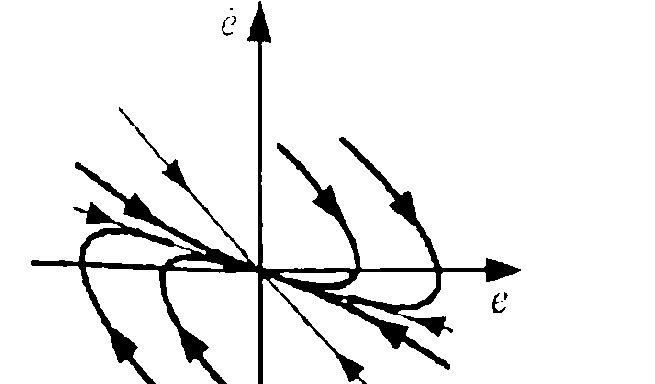
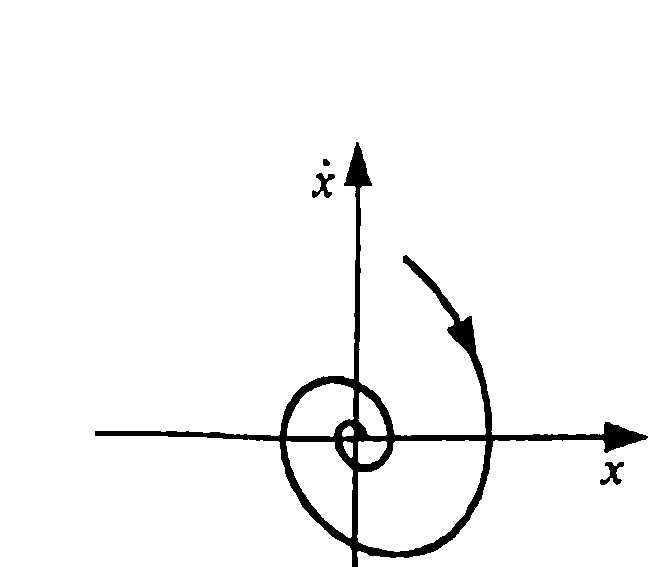
其特征方程为 Tλ2+λ+K=0T\lambda^2+\lambda+K=0  奇点为 (0,0)(0,0)

14TK>01-4TK>0 时,该奇点类型为稳定节点,其相平面图为

图

14TK<01-4TK<0 时,该奇点类型为稳定焦点,其相平面图为

图

五、解:由题可得

A=[0123],B=[20],U(s)=1s+1A=\begin{bmatrix}0&1\\-2&-3\end{bmatrix},\quad \quad B=\begin{bmatrix}2\\0\end{bmatrix},\quad \quad U(s)=\dfrac{1}{s+1}

由题

x˙=Ax+bv\dot x=Ax+bv

sxx(0)=Ax+Bv\therefore sx-x(0)=Ax+Bv

(sIA)x=x(0)+Bv(sI-A)x=x(0)+Bv

x˙(s)=(sIA)1x(0)+(sIA)1BU(s)\therefore\dot x(s)=(sI-A)^{-1}x(0)+(sI-A)^{-1}BU(s)

=[s+3(s+2)(s+1)1(s+2)(s+1)2(s+2)(s+1)s(s+2)(s+1)][01]+[s+3(s+2)(s+1)1(s+2)(s+1)2(s+2)(s+1)s(s+2)(s+1)][20]1s+1=\begin{bmatrix}\dfrac{s+3}{(s+2)(s+1)}&\dfrac{1}{(s+2)(s+1)}\\[8pt]\dfrac{-2}{(s+2)(s+1)}&\dfrac{s}{(s+2)(s+1)}\end{bmatrix}\begin{bmatrix}0\\1\end{bmatrix}+\begin{bmatrix}\dfrac{s+3}{(s+2)(s+1)}&\dfrac{1}{(s+2)(s+1)}\\[8pt]\dfrac{-2}{(s+2)(s+1)}&\dfrac{s}{(s+2)(s+1)}\end{bmatrix}\begin{bmatrix}2\\0\end{bmatrix}\dfrac{1}{s+1}

x1(t)=e2tet+4tetx_1(t)=e^{-2t}-e^{-t}+4te^{-t}

x2(t)=3et2e2t4tetx_2(t)=3e^{-t}-2e^{-2t}-4te^{-t}

Discussion

Comments

Post

Thoughts, corrections, and follow-up notes are welcome here.